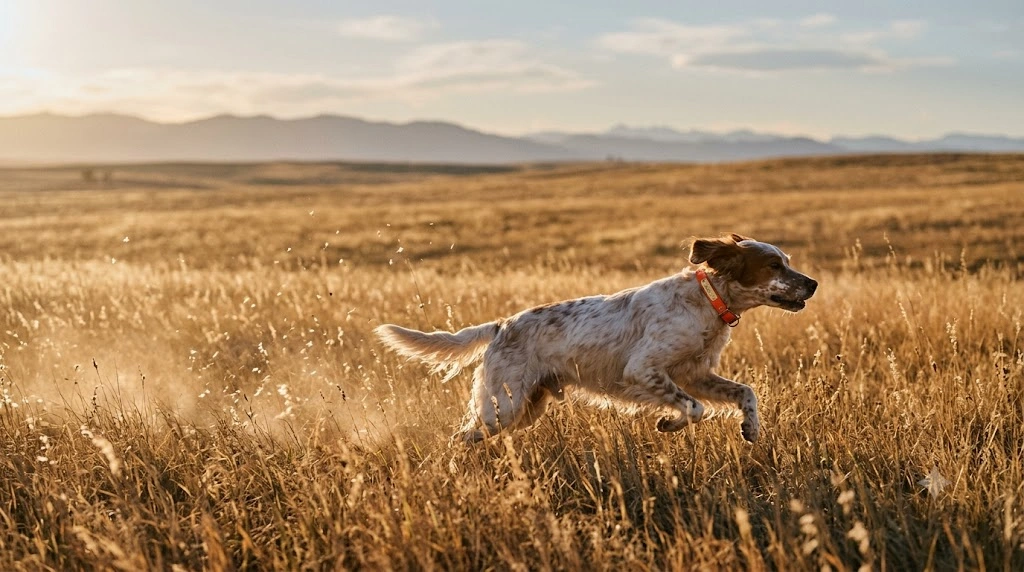
The wind switches out of the north and your setter takes it. One minute she’s quartering the CRP edge two hundred yards out, the next she’s a dot on the far side of a draw, then she’s nothing at all. You glass the horizon. You check the handheld. The prairie east of the Front Range swallows dogs the way timber swallows sound — there’s no cover to stop them and no fence line for a mile.
Most of the time this story ends fine. She circles back, or you walk her down, or the tracker puts you on her in ten minutes. But every hunter who has run dogs long enough has had the other version of that afternoon: the one where the battery quit, or the collar came off in a wire fence, or a rancher three sections over loaded a friendly bird dog into his truck because he had no idea who she belonged to.
That last scenario is the one a name plate solves, and it’s the one most handlers never plan for.
What a Name Plate Collar Is (and Why It Beats a Hanging Tag)
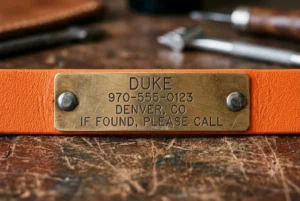
A name plate collar carries your contact information on a flat metal plate riveted directly to the strap. There’s no ring, no split key hoop, no dangling disc. The plate becomes part of the collar itself.
Dog collars with name plates have been standard equipment in the working-dog world for decades, long before GPS existed. Houndsmen, field trialers, and market breeders all landed on the same conclusion independently: if identification can fall off, eventually it will.
The difference between a plate and a tag comes down to three things:
- Permanence. A riveted plate stays attached for the life of the strap.
- Profile. A plate lies flat against the collar with nothing to catch.
- Silence. Nothing swings, so nothing rings.
For a house dog on a leash, a hanging tag is fine. For a dog covering ground at speed through country designed to shred gear, it isn’t.
Why Hanging ID Tags Fail Hunting Dogs
Hanging tags fail in specific, predictable ways, and every one of them shows up in bird country.
They snag. Sagebrush, plum thicket, downed barbed wire, woven-wire fence, the gap under a gate — a tag on a ring is a hook looking for something to hook. Sometimes the tag tears free and you never notice. Sometimes the dog does not tear free, which is worse.
They make noise. Two tags on a ring jingle with every stride. On wild pheasants late in the season that noise costs you birds, and plenty of handlers pull tags off before a hunt for exactly that reason. A collar that gets stripped before every hunt is not identification. It’s decoration.
They wear illegible. A brass or aluminum disc that spends three seasons slapping against a buckle and dragging through sand does not stay readable. Engraving fills with grit and flattens out. The one time someone actually needs to read it, they can’t.
They disappear in cover. Cattails, willow, snow — a tag that comes off in heavy cover is gone. You won’t find it and you usually won’t know it’s missing until you go looking.
None of this is theoretical. It’s just what happens to hardware that swings freely on a dog that runs hard.
GPS Is Not Enough on Its Own
Let’s be straight about this, because it matters more than any marketing angle: a GPS tracking collar is the single most effective tool ever made for recovering a lost hunting dog. Nothing else comes close. If you run big-running dogs in open country and you don’t have one, that’s the first purchase to make — before a name plate, before anything else.
But a tracking collar is a system, and systems have failure points.
- Battery. Run a dog hard on a cold day at altitude and battery life is shorter than the spec sheet suggests. A collar that dies at hour nine on a dog that went missing at hour eight is not going to find her.
- The handheld. Tracking requires you to be holding the other half. Drop it, break it, drain it, or leave it in the truck, and the collar on your dog’s neck is a very expensive strap.
- Terrain and distance. Line of sight is not guaranteed in canyon country or heavy timber. Signal comes back, but “eventually” is not the same as “now.”
- The collar comes off. A dog that slips a collar in a fence is now untracked, and the collar is lying in the grass wearing all of your dog’s identification.
- Someone else finds her first. This is the big one. A stranger who picks up a friendly bird dog on a county road cannot read a GPS unit. They can read a plate.
The right way to think about this is layered identification, and each layer covers a different failure:
- GPS tracking — real-time location, while it has power and signal. This is how you find your dog.
- Microchip — permanent and unlosable, but invisible. It only works if the dog reaches a vet or a shelter with a scanner, which can take days.
- Name plate — instantly readable by any person who ends up standing next to your dog. No battery, no scanner, no delay.
The plate is the layer that works when the other two haven’t. It costs almost nothing and it’s the one that turns a stranger into a phone call.
Running dogs in open country this season? Browse the full lineup of GPS tracking collars at Front Range Gun Dog and get the tracking layer handled first.
What to Engrave — Getting the Four Lines Right
A name plate only has so much room, and most people waste it. The plates we engrave use a four-line format, and how you use those four lines matters more than most handlers expect.
Line 1 — Dog’s name Line 2 — City and state Line 3 — PLEASE CALL + phone number Line 4 — Additional line (commonly NEEDS MEDICATION or a second number)
Here’s how to think about each one.
The phone number is the whole point
Everything else on the plate is context. The number is the action. Make sure it’s engraved large and clean, and use the number you actually answer in the field — not a landline sitting in an empty house while you’re four hours from home. If you hunt with a partner regularly, a second number on the fourth line covers you when you’re out of service.
“PLEASE CALL” ahead of the number is not filler. It tells someone who has never dealt with a lost dog exactly what to do next.
City and state does real work
A dog can travel a long way in a day, and further than that in a truck. City and state tells whoever finds her that she is a long way from home and someone is missing her badly. It converts “stray dog” into “somebody’s dog.”
“NEEDS MEDICATION” is the line that gets you a call tonight
This is the most underused line on any plate. A finder who reads needs medication stops thinking about it as a problem to deal with tomorrow. It creates urgency, and urgency is what turns “I’ll take her to the shelter Monday” into a phone call from the side of the road.
Some handlers use this line even when the dog isn’t on daily medication, on the reasoning that a dog running loose in unfamiliar country is a dog that may well need attention. That’s a judgment call — but understand the effect it has on whoever reads it.
Why some handlers leave the dog’s name off
This one surprises people. A stranger who can read your dog’s name off the collar can call your dog — and a dog that comes to a stranger is a dog that can be led toward a road, loaded into a vehicle, or walked off a property. Handlers who run valuable dogs, or who hunt near highways and busy county roads, sometimes drop the name entirely and use that line for a second phone number instead.
There’s no universal right answer. Just make the choice deliberately rather than by default.
Why Brass, and Why Riveted
Material and attachment are not details. They’re the difference between identification that lasts one season and identification that lasts the life of the dog.
Brass does not rust. It goes through cattail sloughs, iced-over stock ponds, spring mud, and late-season snow and comes out the other side still legible. Engraving cut into brass stays sharp because the metal is hard enough to hold an edge but soft enough to cut cleanly.
Riveted means the plate is fixed flat to the strap through the strap itself. It cannot spin off a ring, cannot be pulled loose by a fence wire, and presents no edge for cover to catch. A dog can run cheatgrass, cactus, and greasewood all season and the plate does not move.
The combination is boring, unglamorous, and exactly why it has been the standard on working dogs for a hundred years.
Getting Both on One Collar — the Garmin Alpha Setup
Most retailers treat this as two purchases. Buy the tracking collar, then go find someone to make you a plate, then figure out how to mount it without interfering with the GPS unit.
We don’t do it that way. Every Garmin Alpha collar we sell ships with a free custom engraved brass name plate and your choice of strap color, riveted and ready to hunt out of the box. Free shipping, no upcharge for the engraving.
Strap color is worth a moment of thought too. If you run more than one dog, color-coding straps lets you identify which dog is which at four hundred yards through binoculars, and makes sorting collars in the dark at 5 a.m. considerably less frustrating.
Three collars cover most handlers:
- Garmin Alpha TT 25 — the standard track-and-train collar. Tracking plus training stimulation in one unit, which is what most upland and waterfowl handlers want on a dog that’s still developing or needs reinforcement at distance.

- Garmin Alpha TT 25 EXT — the extended-antenna version, built for big-running dogs and broken country. If your dog regularly gets out beyond where you’re comfortable, or you hunt canyons, draws, and terrain that eats signal, this is the one to look at.
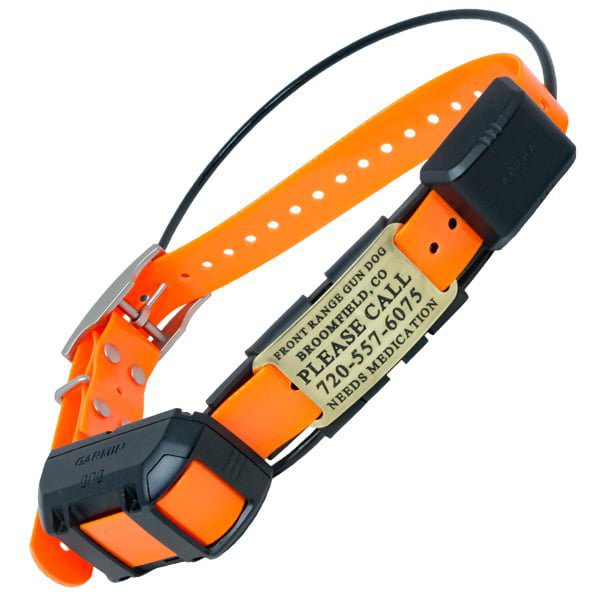
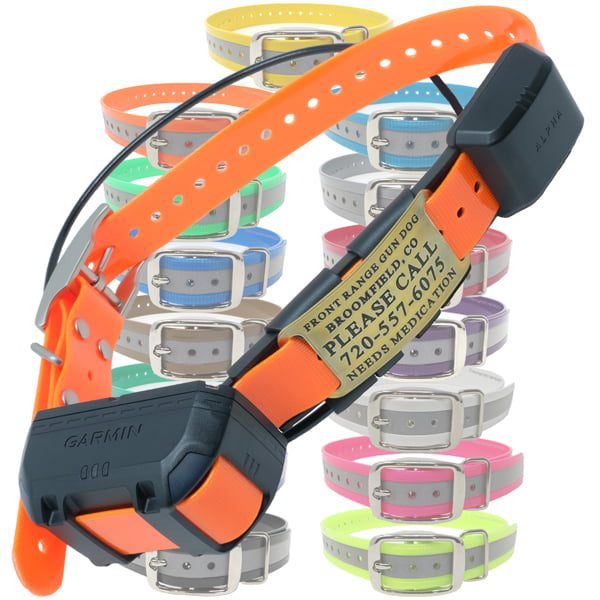
- Garmin Alpha T 20 — tracking only, no training stimulation. The right choice for a finished dog that doesn’t need correction, or for handlers who prefer to keep training and tracking separate.
All three carry the same free engraved plate. Whichever you choose, your dog leaves with both layers on one strap.
Fit and Placement for Working Dogs
A plate and a GPS unit have to share real estate. Get the layout right and neither one bothers the dog.
- Two-finger rule. You should be able to slide two fingers between strap and neck. Any looser and the collar can be slipped or rotated; any tighter and you’ll have chafing by midday.
- Position the GPS unit high on the neck. It sits best just behind the jaw where it stays above cover and the antenna has the clearest path.
- Keep the plate off the contact points. On a track-and-train collar, mount the plate on the opposite side of the strap from the stimulation contacts so nothing interferes with contact or comfort.
- Check the fit again after a hard day. Straps stretch and dogs lose weight over a long season. A collar that fit in October can be loose in December.
- Consider running a second collar. Plenty of handlers run a leather name plate collar full-time — in the truck, in the yard, in the kennel — and add the GPS collar only for hunts. That way the dog is never wearing zero identification, which is the actual worst case.
Frequently Asked Questions
Does a name plate replace a microchip? No. They cover different failures. A microchip is permanent but requires a scanner, so it only works once the dog reaches a vet or shelter. A plate works the moment someone reads it. Run both.
What if my dog already has a Garmin collar? Then you likely already have a strap that a plate can be riveted to, or you can run a separate ID collar alongside it. Either approach works — the goal is simply that your dog never leaves the truck without readable contact information on her.
Can a name plate be re-engraved? Engraving is permanent, so a plate cannot be changed once it’s cut. If your phone number changes or you move, you replace the plate rather than modify it. Plates are inexpensive relative to a tracking collar, so this is a minor cost.
Will the plate make noise in the field? No. A riveted plate lies flat against the strap and has nothing to swing against. That’s precisely why it doesn’t cost you birds the way a pair of hanging tags will.
Should I put my address on the plate? There isn’t room for a full address, and it isn’t necessary. City and state plus a phone number you actually answer does the job better and leaves room for the fourth line to work.
Get Both Layers on One Strap
Identification is the cheapest insurance you will ever buy for a dog that took you two years and a lot of birds to develop. GPS finds your dog when the system works. A riveted brass plate brings her home when it doesn’t.
At Front Range Gun Dog in Broomfield, Colorado, every Garmin Alpha collar ships with a free custom engraved name plate and your choice of strap color, with free shipping. We’re hunters running dogs in the same CRP, the same prairie, and the same broken country you are — so if you’re not sure whether the TT 25, the TT 25 EXT, or the T 20 fits your dog and your ground, call us and we’ll talk it through.
Order the collar, send us the four lines, and it arrives ready to hunt.